The Date Detectives: Unpacking Every Major 2026 Game Delay — Official Story vs. What We Actually Think Happened
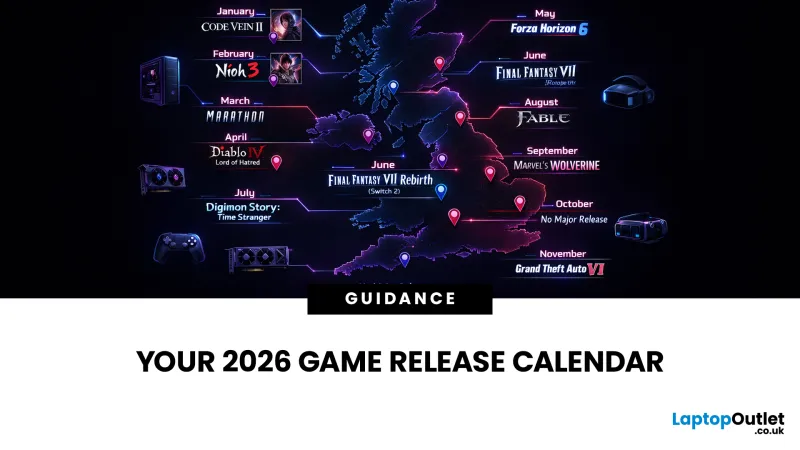
Photo: video game release date calendar official, via static-media.laptopoutlet.co.uk
The Date Detectives: Unpacking Every Major 2026 Game Delays — Official Story vs. What We Actually Think Happened
Every game delay announcement follows roughly the same script. A carefully worded statement drops — usually on a Friday afternoon, usually via social media — explaining that the team needs "a little more time" to deliver the experience players deserve. It's signed with gratitude, padded with appreciation for fan patience, and almost entirely free of specifics. Then the discourse starts, and the real question surfaces: is this actually about the game, or is this about something else?
In 2026, that question has come up a lot. The release calendar has shifted more dramatically than any comparable year in recent memory, with high-profile titles moving weeks, months, and in some cases over a year from their originally announced windows. We went looking for the truth behind the talking points — and what we found is more complicated than either "they needed more time" or "the suits moved the chess pieces."
The Official Language of a Delay (And How to Read It)
Before getting into specific patterns, it's worth establishing a quick decoder ring for delay announcement language, because publishers have developed a remarkably consistent vocabulary for these moments.
"We want to make sure we deliver the best possible experience" — This is the baseline. It means almost nothing on its own and is present in virtually every delay statement regardless of the actual reason.
"Based on feedback from our community/playtesters" — This one's more specific and, when genuine, usually indicates that a beta or preview event surfaced real problems. When it appears in a statement for a game that hasn't had any public-facing test period, treat it with skepticism.
"To give the team the time they need" — This phrasing often signals internal development pressure rather than a quality decision from the top. It's the language of a studio that pushed back on a deadline and got partial relief.
"To avoid a crowded release window" — Unusually honest when it appears. This is a business decision stated as a business decision, and it at least has the virtue of not pretending otherwise.
"We're excited to share more soon" — The delay announcement that doesn't include a new date. Treat this as the most concerning category. It means the publisher doesn't know when the game is coming out, and they're not ready to tell you that directly.
The Calendar-Juggling Delays
Some of 2026's date shifts have very little to do with the games themselves and a lot to do with competitive release positioning. This is a real, legitimate business consideration — launching a mid-budget title against a major franchise release in the same genre is a commercial decision that can affect sales by a meaningful margin. Publishers have always done this, and it's not inherently dishonest.
What is a problem is when calendar-juggling delays get packaged in quality language. If a game is moving because it doesn't want to compete with a bigger release, that's fine — say that. The industry has gotten better at this in some corners (a handful of publishers have been refreshingly direct about competitive positioning in 2026), but the default is still to reach for the polish narrative even when it doesn't fit.
The tells are usually in the timeline. A game that announces a delay less than six weeks before its original launch date, moves roughly 60 to 90 days, and then doesn't show any substantially different content in subsequent marketing? That's a calendar move. The game was probably mostly done. It needed a cleaner runway, not more development time.
The Genuine Polish Delays
These exist too, and it's important to give credit where it's due. Several 2026 titles have moved their dates and then demonstrably shown up differently — with tightened performance metrics, resolved technical issues flagged in previews, or gameplay systems that clearly benefited from the additional time. These are the delays that actually work the way the announcement claims.
The distinguishing characteristics tend to be: a longer delay window (three months or more), specific acknowledgment of what's being fixed even if vague, and subsequent preview coverage that reflects tangible improvement. When developers can point to something concrete — frame rate targets hit, a troubled multiplayer component rebuilt, a narrative act reworked after internal testing — the delay statement lands differently because it has something to stand on.
It's also worth noting that some of the most commercially and critically successful games of the past decade were delayed, and several of 2026's most promising titles fall into this category. Patience has historically been rewarded more often than punished when the delay is real.
The Delays That Are Actually Cancellations in Slow Motion
This is the hardest category to write about and the most important one to flag. Some games that have "delayed" in 2026 are not, in any meaningful sense, still in active development toward a release. The delay announcement was a way of buying time before a harder conversation — a cancellation, a significant restructuring, or a pivot so dramatic that what eventually ships (if anything does) will barely resemble what was originally announced.
The signals here are subtle but learnable. Watch for: a delay announcement that comes without any new footage or assets; a game that goes quiet on social media immediately after the delay; a studio that announces layoffs within a few months of a delay; and most tellingly, a game that gets delayed and then doesn't appear at the next major showcase opportunity where it logically should have been featured.
None of these individually confirm the worst, but together they paint a picture worth paying attention to.
What This Tells Us About 2026's Release Calendar
The volume of shifts in 2026 reflects a release calendar that was significantly over-promised during the 2024-2025 announcement cycle. Studios were emerging from pandemic-era development disruptions, publishers were eager to signal a return to normal output, and a lot of windows got staked out optimistically. Reality has since intervened.
The net result is a release calendar that's more back-loaded than anyone planned, with Q3 and Q4 2026 carrying a volume of major releases that would have been spread across a full year in a healthier cycle. That's good news for players in the sense that there's a lot coming. It's complicated news in the sense that a lot of those games are going to be competing for the same dollars and the same hours at the same time.
The Verdict
Delay announcements in 2026 are telling you something — you just have to know how to listen. Most of them are a mix of real development need and real business calculation, and the honest answer for most titles is probably somewhere in the middle of both. The games worth staying patient for are the ones that can show you — not just tell you — what changed.